Paris remet la table
Seven years after siege and hunger, Paris receives the world again. La ville reprend sa place.
In 1878, Paris does more than announce its recovery. The Exposition Universelle extends from the Champ-de-Mars to the new Palais du Trocadéro, gathering industry, decorative arts, machines and national ambitions in one immense field of comparison. The city has known war, siege, hunger and the Commune. Now it receives exhibitors and visitors again, not as a convalescent capital but as an authority. Paris ne se montre pas : Paris se rétablit.
The table is everywhere, although no pavilion gives it that name. It appears in chased silver, enamel, blown glass, porcelain, service pieces, refrigeration machinery and wines whose continuity is already threatened by phylloxera. Each craft is presented separately. Seen from the dining room, they form a single system: how food is preserved, carried, presented, poured and remembered. Des métiers dispersés deviennent un art de recevoir.
Un service traverse l’Atlantique
One object makes the international movement tangible. In 1877, John and Marie Louise Mackay commission Tiffany & Co. to create a dinner service for twenty-four. The silver comes from Nevada’s Comstock Lode, the source of the fortune that made the order possible. About half a ton is sent to New York. Two hundred craftsmen work for almost two years; the completed service comprises more than 1,250 pieces.
Before reaching a private table, the Mackay Service crosses the Atlantic. It forms part of the display for which Tiffany & Co. receives the Grand Prix for silverware at the Paris Exposition. American material and manufacture come to Paris to be judged. Paris, in return, gives them international authority.
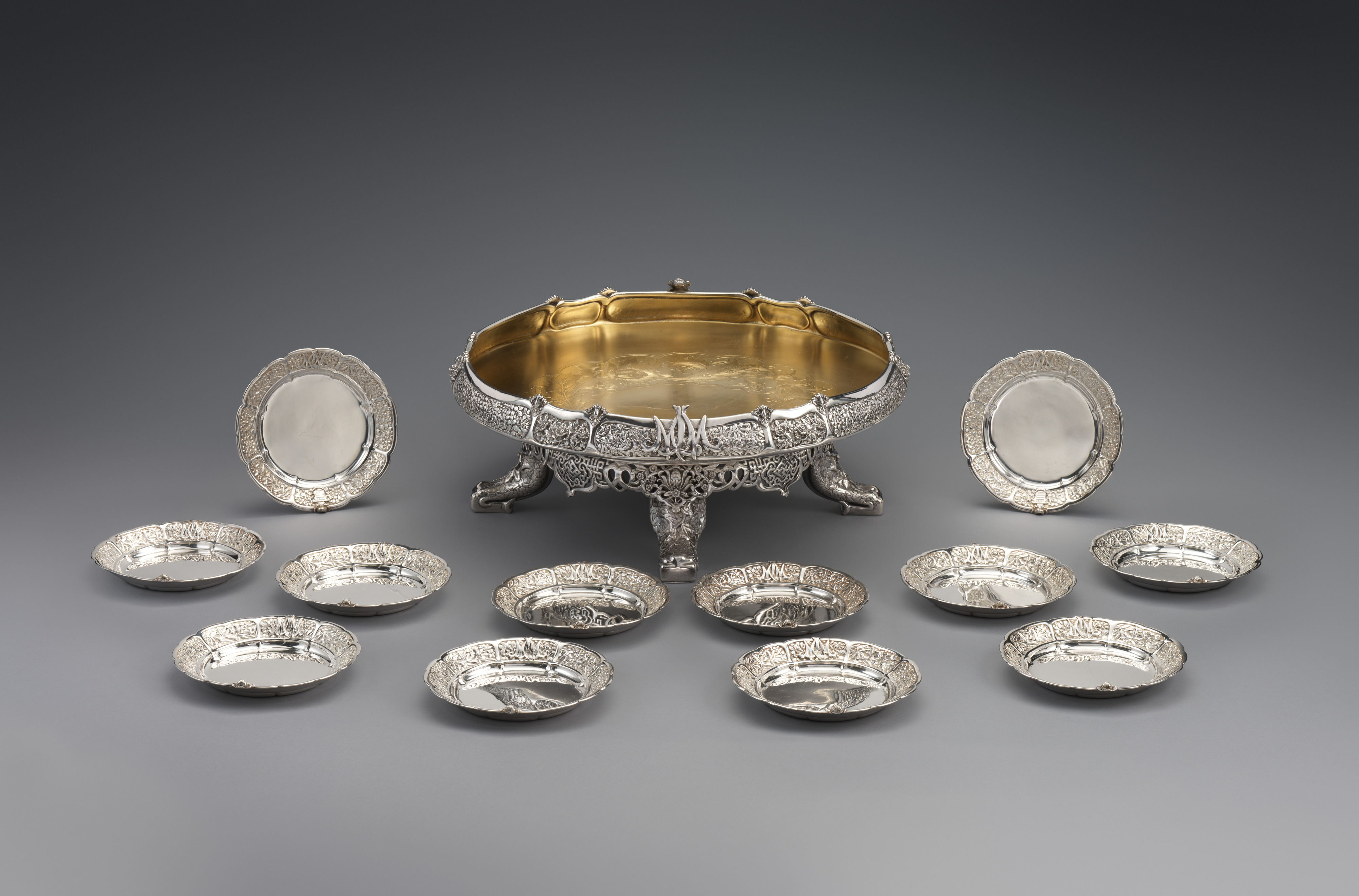
The Metropolitan Museum of Art, New York. Purchase, Anonymous Gift, 2023. Dish: 2023.94.1.
The Met · collection record · Public Domain / Open Access
The journey ends only a few hundred metres from the Arc de Triomphe, at 9 rue de Tilsitt, where the Mackays have established their Paris home. Silver taken from the American West, transformed in New York and consecrated at the Exposition now enters a private dining room. Le monde industriel devient service; le service devient signe; le signe trouve sa place à table.
The Mackay Service moves from a private commission to a public exhibition, then back to the table. An object made for dinner carries the history of that journey.
La table, au-delà de l’objet
Elsewhere in the city, the movement is just as decisive and far less ceremonial. The bouillon establishes a durable Parisian proposition: feed many people, quickly, in a recognisable room, at a price that permits return. At the opposite end, silver, crystal and mature wines codify international reception. Paris does not choose between the popular table and the table of state. Elle maintient les deux, avec des gestes différents et une même exigence de continuité.
The Exposition also makes cold visible as infrastructure. Machines promise to preserve food and control temperature; transport shortens distances; a restaurant can imagine supplies, cellars and service on another scale. None of this abolishes the old gestures. It gives them reach. The modern Paris table will depend as much on invisible systems as on the hand that places a plate.
A menu from the decades that follow can therefore be read as more than a list of dishes. It records what preservation made possible, what transport delivered, what vineyards survived and what a room considered proper service. The document is modest; the system behind it is immense. C’est ainsi qu’une table devient une archive de la ville.
1878 therefore matters less as a date of invention than as a moment of assembly. Paris brings together the democratic meal, the ceremonial service, international craft, threatened vineyards and the technical means of preservation. It turns separate evidence into a culture. La capitale ne crée pas tout. Elle choisit, ordonne et consacre.
L’Exposition de 1878 n’invente pas la table moderne. Elle la rassemble.